Transportation Electrification
The CPUC plays a critical role in supporting the state’s transition to zero-emission vehicles (ZEVs). As regulators of the state’s electric investor-owned utilities (IOUs), the CPUC applies its expertise and experience in electric rate design, electric system infrastructure deployment, grid management, and safety to support ZEV deployment. The CPUC also works closely with other state agencies to ensure electric IOU investments to support ZEVs are strategically coordinated and in the interest of ratepayers. The CPUC’s activities on transportation electrification primarily fall into six main categories:
- Strategic planning on ZEV policy and investments
- Electricity rates and cost of fueling
- Distribution infrastructure and planning to support charging infrastructure
- Vehicle-grid integration (VGI) policy, pilots, and technology enablement
- Charging infrastructure deployment and incentives
- Program evaluation and interagency coordination
California has established many goals for transportation electrification to accelerate the adoption of ZEVs and increase access to charging stations which guide the CPUC’s work on transportation electrification. The tables below summarize several of the key pieces of legislation and Executive Orders that guide our work.
| Bill | Sponsor | Year | Short Description |
|---|---|---|---|
| SB 350 | De Leon | 2015 | Clean Energy and Pollution Reduction Act of 2015 |
| AB 1082 | Burke | 2017 | Electric Vehicle Charging Infrastructure: School Facilities and other Educational Institutions |
| AB 1083 | Burke | 2017 | Electric Vehicle Charging Infrastructure: State Parks and Beaches |
| SB 1014 | Skinner | 2018 | California Clean Miles Standard and Incentive Program: Zero-emission Vehicles |
| SB 1000 | Lara | 2018 | Electric Vehicle Charging Infrastructure |
| AB 2127 | Ting | 2018 | Electric Vehicle Charging Infrastructure:assessment |
| SB 676 | Bradford | 2019 | Electric Vehicles-Grid Integration |
| AB 841 | Ting | 2020 | Energy: Transportation Electrification and School Energy Efficiency Stimulus Program |
| AB 2061 | Ting | 2022 | Transportation Electrification: electric vehicle charging infrastructure |
| E.O. | Governor | Year | Short Description |
|---|---|---|---|
| N-79-20 | Newsom | 2020 | Established goal for all in-state sales of new passenger vehicles to be zero-emission by 2035; 100% medium- and heavy-duty vehicles be zero-emission by 2045; for all operations where feasible, and by for drayage trucks; and 100 percent zero-emission off-road vehicles and equipment by 2035 where feasible |
| B-48-18 | Brown | 2018 | Established target five million ZEVs by 2030, and 250,000 public EV charging stations; 10,000 of which should be fast chargers |
| B-16-12 | Brown | 2012 | Established target of one million ZEVs on the road by 2025 |
Strategic Planning on ZEV Policy and Investments
In December 2018, the CPUC launched an Order Instituting Rulemaking (OIR) to Continue the Development of Rates and Infrastructure for Vehicle Electrification (R.18-12-006, DRIVE Rulemaking) to refocus transportation electrification efforts. The DRIVE Rulemaking directed Energy Division staff to develop a framework for reviewing IOU roles and investment priorities for transportation electrification. In response, Energy Division staff issued the draft
Transportation Electrification Framework (Draft TEF) in February 2020.
The Draft TEF proposed a process to move beyond the ad hoc approach to investment in transportation electrification to date, and would have required the IOUs to, among other things, file 10-year transportation electrification plans and file program proposals on an established schedule in support of these plans. However, based on stakeholder feedback on the Draft TEF and key policy and investment developments since the issuance of the Draft TEF, including Assembly Bill (AB) 841 (Ting, 2020), decisions authorizing further light-duty charging investment for SCE and SDG&E, and a decision in July 2021 that established near-term priority transportation electrification investment areas, Energy Division staff issued a follow up staff proposal to modify certain elements of the Draft TEF proposal.
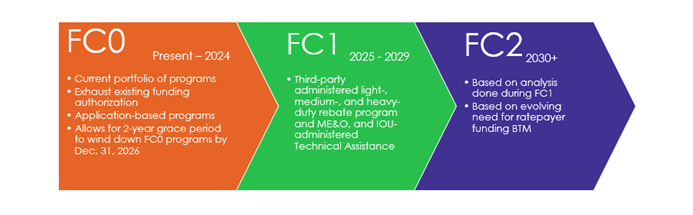
In February 2022, another staff proposal was issued to propose a new five-year funding cycle approach to transportation electrification and recommended the CPUC authorize up to $1 billion in ratepayer funding between 2025-2030 for rebates for behind-the-meter (BTM) EV charging infrastructure.
In November 2022, the CPUC adopted the five-year funding cycle proposal, ratepayer funding of $600 million starting in 2025 with the potential to access up to $1 billion, and resolved other outstanding issues from the Draft TEF. This decision categorizes the existing collection of transportation electrification programs as Funding Cycle 0 (FC0), establishes Funding Cycle 1 (FC1) that will launch in 2025 focused on rebates for BTM charging infrastructure and supporting programs, and outlines a yet to be defined/determined Funding Cycle 2 (FC2) launching in 2030.
Figure 1: Funding Cycles
Beginning in 2023, the CPUC, IOUs, and stakeholders will begin the process of implementing FC1. This will include selection of a third-party program administrator, numerous workshops on outstanding programmatic details, and a subsequent CPUC decision to adopt a FC1 Program Handbook.
CPUC Contacts
|
Topic |
Name |
Contact |
|
TE Section Supervisor |
Paula Gruendling |
Paula.Gruendling@cpuc.ca.gov |
|
Proactive Planning for TE Infrastructure and Freight Infrastructure Planning VGI Policy, Pilots and Planning TE Proceeding Lead, R.23-12-008 |
Audrey Neuman |
|
|
EV Infrastructure Rules and Energization AB 50/SB 410 Energization Proceeding Lead
|
Emmanuelle Truax |
|
|
Funding Cycle and Funding Cycle 1 Low Carbon Fuel Standard |
Brandon Gerstle | Brandon.Gerstle@cpuc.ca.gov |
|
Light-duty Program Oversight and Evaluation
|
Katherine "Katie" Pratt | Katherine.Pratt@cpuc.ca.gov |
|
Medium-and-Heavy-Duty Program Oversight and Evaluation Freight Infrastructure Planning Technical Assistance Program Oversight |
Emily Clayton | Emily.Clayton@cpuc.ca.gov |
How To Participate In Our Proceedings
There are two ways to receive information related to a Commission proceeding:
- Join a proceeding service list to receive e-mails with all documents sent by the Commission, by parties participating in the proceeding, as well as notices of workshops or other events. Visit https://www.cpuc.ca.gov/become_a_party/ for instructions on how to become a party to a proceeding.
- Sign up for the Commission's Subscription Service to follow a particular proceeding, industry, or type of document. Note that you will only receive documents from the subscription service once they have been accepted for filing, so there will be a delay in receiving notification of filed document. Additionally, some types of documents, such as testimony and other communications, are not provided via subscription service and are sent only to the service list.